Keep rotating
Satellite Lot return with Sleepwalk in a Burning Building
No fair naming names, but not long after my list of the top local albums of 2005 was released with Satellite Lot’s Second Summer at the top I got an email from a band whose album I’d sort of panned: “Hey, I just picked up Second Summer … this album fucking ROCKS. Good choice, definitely number one. I’ve never heard anything this good out of Portland. Are there any other bands you would recommend in the area making music this good?”
Well, sure, I wrote back, there’s Cult Maze, An Evening With, Phantom Buffalo, Diamond Sharp, the Enchantments – and those are just the bands making great music in Portland within the same genre. But that debut record was certainly remarkable in part because it was so unexpected. Though they’d been playing in Portland in various forms for a good five years, no one would have told you in 2005 that Satellite Lot were one of the biggest draws, that’s for sure, nor a favorite to put out the best album of the year.
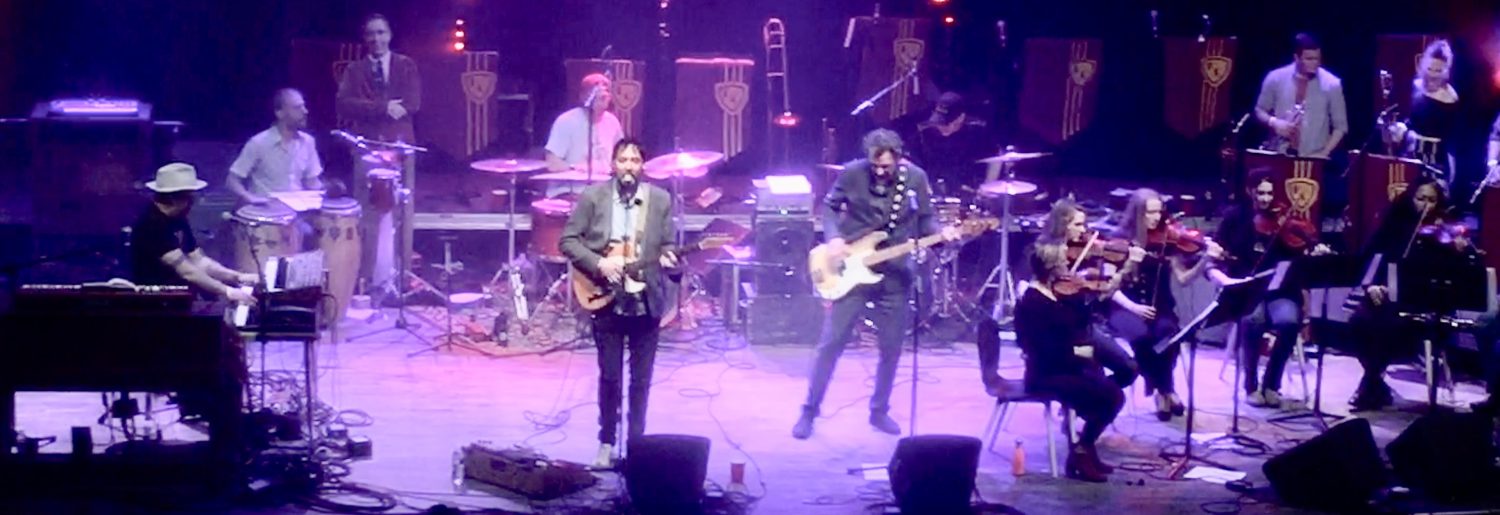
 Two years later, the band remain something of an enigma—incredibly well respected, yet unable to keep a stable lineup in place, only rarely playing out in Portland, and about to release a follow-up record, Dec. 14 at SPACE [this originally ran in 2007], that would seem to have come out of the blue. And the album they’re delivering was recorded entirely in their practice space, mixed and mastered by guitarist and more Casey McCurry, without any professional studio intervention.
“It still sounds like clown shoes,” McCurry offers. “Everybody tells me it sounds really good, but it never sounds even close enough to a real record for us.” So why not record with a local studio? “With the process we use to write songs,” McCurry says, “we wouldn’t be able to go into a studio until we grow up or something.”
Judging by the results found on Sleepwalk in a Burning Building, the tradeoff is worth it. Yes, the instruments can sound mushy at times, and the vocals are buried on some tracks, making good lyrics hard to parse, but the songwriting is terrific—organic, original, dense and slippery. Slightly tighter focused than Second Summer, Satellite Lot here trade in some Jersey rock for the dance pop of bands like the Call, the Alarm, and Duran Duran, trading heavily on synthesizers and electronically enhanced beats.
“Never Again” leans more toward the rock, driven by Ben Landry’s heavy snare and finishing grandly with a reverb-laden guitar hook. In the middle, Aaron Hautala delivers the unrequited love song that became his stock in trade on Second Summer: “Tell me one thing/ It’s just killing me/ How long, how long did you know/ That the life you’d grown to love would end in misery/ Explode in my face?”
Yet the following “Liberation Front” is a change of pace on nearly every front. It opens dance-floor amped, with pulsing digital beats from the synths and a main melody line like something off Like a Virgin, before calming down with a horn section featuring Brian Graham (Sly Chi), Mark Tipton, and Dave Noyes (Seekonk/Rustic Overtones). It’s futuristic like something off the soundtrack to Flash Gordon and downright utopist: “They showed me visions of a future I’m in love with/ I found another way.” For the present, however, “You can just open your eyes and see/ All that suffering/ Open your heart and feel/ All that you’re meant to feel.”
Nor do the band live entirely in the past with their references. “Werewolf Wolf” is alive with Killers guitars and Minus the Bear vocals. “Devil’s Details,” featuring anesthetized lead vocals from the now-departed Sydney Bourke, has guitar bursts like Tegan and Sara. Some of the more morbid lyrics (“Brick Tiger”: “Timing is everything/ They’ll find me, with a rope around my neck”) even have a contemporary touchpoint with Hautala’s dad, horror writer Rick Hautala (how I missed that connection last time around, I have no idea).
With tracks that start at 3:30 and run as long as 6:00, 6:45, and 7:15 on a 12-track disc, there is grist for the pop lover here, as well as the prog sensible. There’s melody and rhythm enough in often many-layered tracks to deconstruct, pull apart, and reassemble. While the instant singalong might be harder to find than on Second Summer, persevere. The album improves with every listen and is damn hard to get out of your player of choice.
 Portland's Best Albums | Maine Music Reviews