North of Nashville: North of Nashville

Enter the Working Man

The outlaw country of North of Nashville

I know: Why do you need a North of Nashville album when they’re probably playing nearby as you read this? There is unquestionably no paucity of North of Nashville. But if frontman Jay Basiner hasn’t won you over by the end of a four-set gig on the back porch of Brian Boru or in the bar at the Rack after a day of skiing, then you’re probably something of a grumpy dick. And if Basiner has, indeed, worked his charm, taking home the duo’s debut, self-titled full-length is an appropriate way to say thanks.

Nor will you regret the purchase. These are easy songs to like and if you throw them into a mix of tracks from Highwaymen like Willing, Merle, Kris, and Johnny they’ll filter comfortably in and provide a few new songs from a genre that’s mostly petered out. Whatever might still be left of “outlaw country” has mostly become the kind of overproduced pap that manages to find Tim McGraw pumpin Lil Wayne on his iPod and guys with open shirts and shaved chests playing brand-new acoustic guitars in front of spotless pick-up trucks.

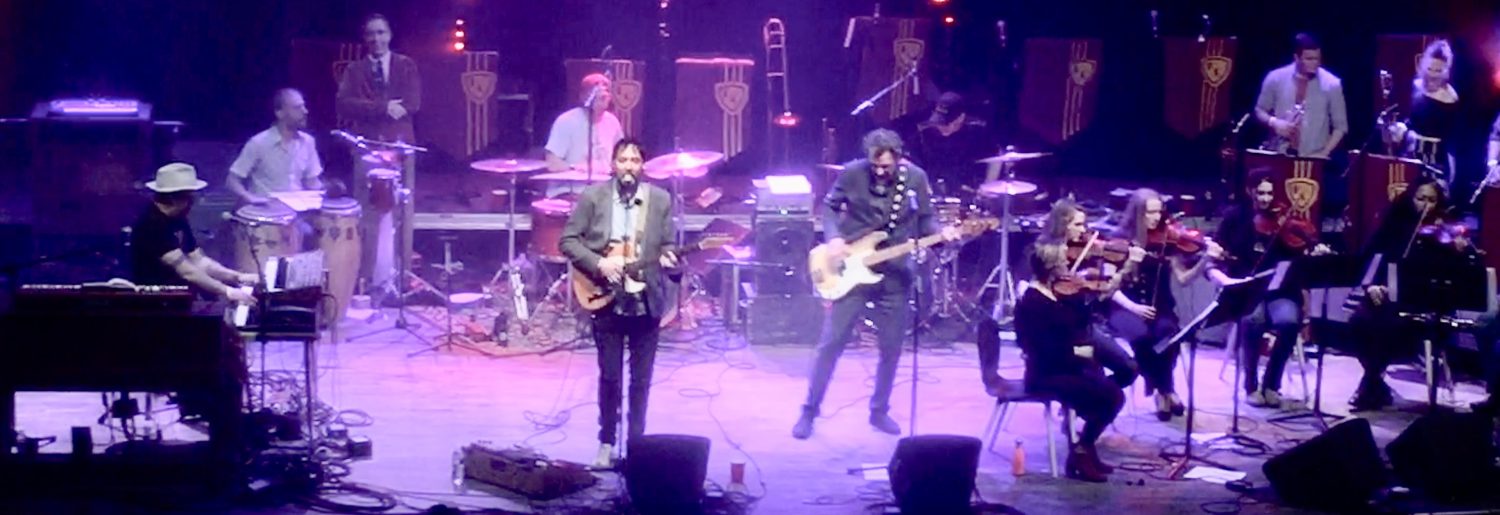
That sure as hell isn’t Basiner and partner-in-crime and mostly fiddle player Andrew Martelle. Basiner has just about worn his guitar out, a la Willie, and Martelle is a top-drawer fiddle player, leaning on this record more toward Charlie Daniels than Vassar Clements. Most of all, though, they make their stories of blue collar work and simple pleasures both believable and endearing.

It’s hard not to think of outlaw countryman and Maine icon Dick Curless when you come across “The Working Man.” It appears seventh on this crisp 10-song album, but is clearly the band’s anthem. “I have no reservations about getting my hands dirty, night and day,” Basiner announces from the open, and the brand of country that follows – with bass drum and high hat alternating beats to emphasize the boom-chick rhythm (Basiner plays with his feet while strumming the acoustic guitar) and Martelle trading fiddle riffs with Basiner’s harmonica – is as literally workingman as it gets.

[This is their live album. Can’t find an embed of their full-length. It’s on the homepage of their site.]

The chorus lets you know why all that on-stage sweating is worth it: “While they’re running ‘round in circles, this working man will cross the finish line/ And I’ll be eatin’ good come supper time.”

Certainly, it’s true that Basiner has made more of his particular reservoir of talent than many of his contemporaries locally. He has been determined for the better part of a decade to make a career out of music, and he has steadily progressed from doing covers as J. Biddy through the transformation of This Way from blues rockers to alt-country jam band. With Martelle, though, who first joined him in This Way, the pair have managed to turn what was mostly a side project to earn extra cash into a legitimate touring band, leaving This Way, as notable Nashville resident Gillian Welch might say, by the wayside.

Maybe his voice doesn’t deserve a ton of credit for his progress, but Basiner has managed to wrangle it into something serviceable (that sounds worse than I mean it), really reaching down in places like the middle of the chorus of “Eyes for Me” for a Cash-like bass delivery where you can just about hear every vocal chord vibration distinctly. He hits his sweet spot with “One Night of Pretending,” earnest and mid-range, and not so strained that you can virtually see his face turning red, as happens a bit on other tunes.

No, if not hard work, it’s Basiner’s songwriting that deserves the most credit for the warm receptions North of Nashville has lately enjoyed. Obviously, he’s made a study of the Bakersfield sound, early ’70s Nashville, Graham Parsons, the cowboy poets, and the long tradition of acoustic Americana, and it shows up in spot-on choruses, pick-me-up bridges, and narratives that smartly progress and make use of the choruses in differing ways. “Hooked on Me” and “Best of What’s Around” are goofy without being silly or corny; “Dreams Come True (For Awhile)” is heartfelt, with a Jimmy Buffett kind of singalong; and you’ll forgive him for the “a capella” rhyme in “Isabella.”

Plus, their arranging – making smart use of Cartwright Thompson on pedal steel, adding in mandolin parts from Martelle to freshen things up – and the sound capture from Jonathan Wyman combine to create a record with virtually no artifice. It’s easily accessible and does well to capture their on-stage energy without being limited by what they could pull off as a two-man operation. The bass parts tracked in are necessary to fill out the low end, especially in the headphones, and it’s nice sometimes to hear the mando and fiddle together, even if you have to imagine mirrored Martelles.

So go out and see them. It’s not hard to find an opportunity, and you just might come home with a souvenir.
By Blood Alone: Seas of Blood

Sailing the Seas of Blood

By Blood Alone’s debut full-length is downright Ptolemaic

Two straight weeks reviewing discs with nautical themes in their packaging and not a sea shanty to be found [this is October, 2007]. These are strange days, indeed. Last week, Anna’s Ghost just seemed to like old-looking stuff, and the schooner (or some other big sailboat—I’m no boat buff) on their disc fit the bill. This week, By Blood Alone have “A Mediterranean Brigantine Drifting onto a Rock Coast in a Storm,” by none other than Willem van de Velde, the Younger, gracing the cover of their Seas of Blood. The painting and record both are fairly epic.

Just as you’d be seriously remiss in skipping a chance to see van de Velde II at the Rijksmuseum during a jaunt through Amsterdam, so too should you take the opportunity to take a listen to By Blood Alone’s first full-length disc, an eight-track work spanning 50 minutes that offers a polished and original sound, mixing elements of progressive rock, goth, classical and pop-rock to create a listenable and engaging series of seascapes.

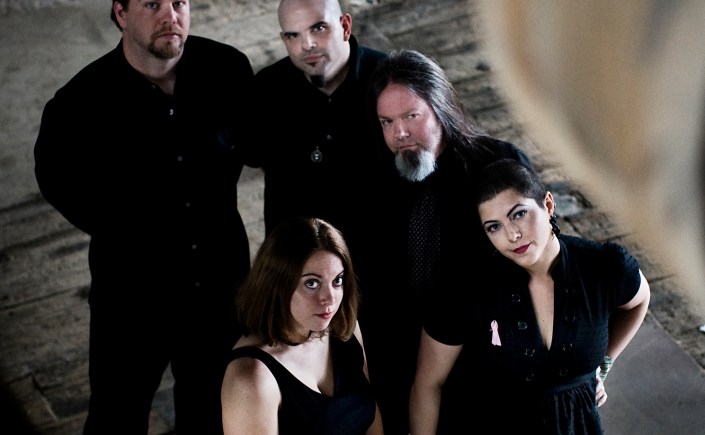
BBA get much of their goth reputation from their look and lyrical themes, trading, too, on Cruella’s languid and fantastical delivery to lend a Romantic (like the artistic movement) feel to everything they do. They are neither as grim and mechanical as Skinny Puppy, however, nor as monotone and humorless as Depeche Mode’s darker days. Instead, they are often a little bit catchy, easy to sing along to, and when they do get aggressive and dark, it’s more in a Rush way than anything else.

They’ll even teach you a thing or two. Their opening “Serpentarius” gets out of the gate very prog, indeed, with John Graveside’s pin-point guitar tightly coordinated with the rhythm section of Jack Doran on bass and Runtt on drums. A 7:30-long ode to the mythical man who invented medical practice, and was thusly struck down by Zeus for depriving Hades of his residents, the song offers Cruella initially querying, “What’s the 13th sign?,” an allusion to the constellation Ophiuchus, Greek for Serpentarius, discovered by Ptolemy in the 2nd century as one of 13 constellations through which the sun travels. The other 12 are astrological signs, but Ophiuchus was passed by in the mathematical desire for 12 to divide nicely into 360.

A keyboard line like a theramin from Jenny Williamson keeps the vibe mystical before the first major instrumental break, where layers of guitars repeat riffs in chord progressions. While progressive as a genre-describer can often just mean nerdy guys into mathematical music and lots of black, By Blood Alone hold true to prog’s basic ideal, also exemplified locally by the likes of Dreadnaught, to actually push contemporary music forward, and their mix of rhythms, keys, and sound levels is always intriguing.

(One other interesting note about Serpentarius: It was the supernova that appeared inside its boundaries in 1604 that Galileo used to show that Aristotle was a dummy with that whole changeless-heavens argument. How’s that for progressive?)

The best thing about this disc is the variety of approaches the band employ, from the simple piano-and-Cruella opening to “Undead Friend” to the heavy grind of “Lovely Lies,” which quickly gives way to dream-like keyboards and Cruella turning singer/songwriter: “I told you once before, that I don’t want your love/ Don’t hold me back, and then you fall to your knees/ Begging me please to take you back into my heart.”

Here, you always get your come-uppance. “Friend” flows into a quick waltz, after a couple of minutes where you wonder whether you might have slipped in the Les Mis soundtrack. The rhythm is held in the piano and cymbals while the keyboards lay down a string section that introduces a third movement with a minor-key fallout straight from the jazz songbook before the song finishes like a big ‘80s ballad. Just when you thought “Lovely Lies” was your standard break-up tune, Cruella steps it up a notch: “I hate you, despise you, just leave me alone.”

Like Camera Obscura’s Tracyanne Campbell, though not as high in the register, Cruella is consistently able to get dark and moody with her content without being dark and moody with her delivery. She and the songwriting combine to make seven-minute-plus tunes—say, “Nidhogg,” about the mythical Norse dragon known alternately as the tearer of corpses and the malice striker as it gnaws at the tree of life—seem almost like they end too soon. And they have further foresight not to put too many tracks on the disc or ask too much of their audience.

The final cut, “Little Lady Lillit” is a sub-three-minute piece of dessert after seven main courses. With a piano like a music box, Cruella triples her vocals into a schoolyard chant about a girl who’s “evil through and through”; to “wreck and crumble, this is what she’d do.” It’s evil in a fun way, and it ends with a purposefully sour note and an infectious giggle.

Who says goths don’t know how to have fun?