OHX: Places

Skeleton crew

OHX debut with people in all the right Places

There was a solid six-month stretch in 2013-2014 where the Other Bones were the best band in Portland. With Loretta Allen’s pipes at the front and an alluring amalgam of digital loops and organic sounds backing her, they had all the danceability of 1989 with all the substance of the Postal Service.

And then they broke up.

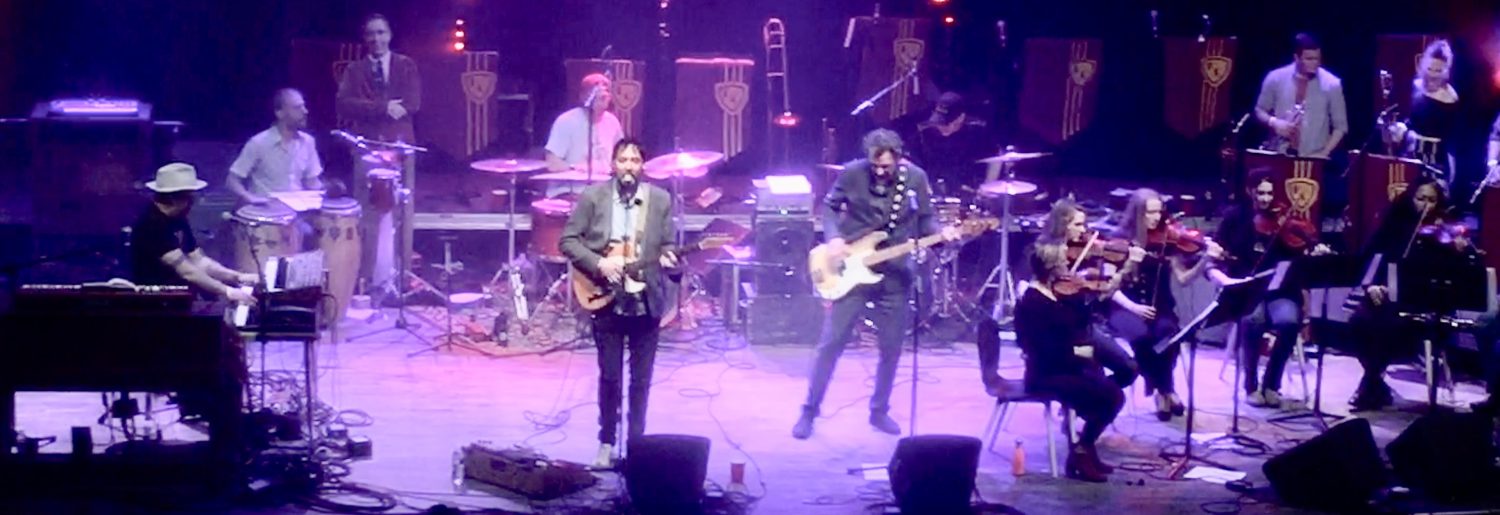
If you were into that, though, you should be excited about OHX. Instrumentalist and songwriter Andrew Mead is a holdover, and he’s put together a collection of instrumentalists and singers (including Allen) over at the Halo that has produced a deeply intriguing set of four songs set for release next week with the Places EP.

They are digitally based and beat- and keyboard-driven, with a solid affinity for the likes of Danger Mouse and the Sea and Cake, and always supplying a hook and melody you can grab onto. For this first release, too, they have rounded up three separate lead vocalists and a guy-gal duo to front their songs, essentially providing a pedestal and spotlight.

The results equal much of the Other Bones’ contemporary promise, tilling new ground in the Portland scene.

My sweet tooth for guy-gal vocals is well established, so it’s perhaps no surprise that I’ve gravitated so strongly to “Blades,” featuring Trent Gay (Arc of Sky) on primary lead, with active support from Renee Spookydawn Coolbrith (Dean Ford), who’s establishing herself as a comer. It’s moody and even creepy in the open, with distorted child-speak and low-end growl that moves into four on the floor and an upbeat keyboard line.

But then there are the vocals. The simple fact is that Trent Gay is the best vocalist on the four tracks here, and the rest of the vocalists are all well regarded for good reason. His precision in delivery is particularly strong, the way he closes off syllables, controls his breath, and adds a huskiness to a higher-register part. Man, it’s good: “How can I know when you don’t say what you mean?/ Please say.”

Coolbrith is lovely in the high harmony — “You’re pulling me deeper into you/ You’re handing me blades, when you’re touching my face” — crisp and cool like these bright, sunny winter days where the sun never seems to get more than four feet from the horizon.

As on all four tracks, OHX do well with the dynamics, pulling back into a clacking rattle of percussion in the second verse, then building back out with Men Without Hats keyboard melody and pulsing beats. It’s really hard not to hear Broken Bells, especially on the opening “The Beginning,” fronted by Crusoe’s Jeremy Spring, who does at times sound like James Mercer when he arcs up toward the tenor. The synth glow and choppy sampling is maybe a touch over-used, but when the vocals enter everything’s forgivable: “Take this now, it’s what you wanted/ You swore you never knew the cost.”

There is a jittery woodblock, builds that show patience and avoid the big drop, a general sense that a bit of trial and error was at work, but there were people in the room smart enough to recognize when they struck gold.

Caleb Sweet combines with Mead to write “Anesthetize” for Anna Lombard, and it’s hard to recall better work from her. She has R&B sass, with an ape of Hall & Oates’ “I Can’t Go for That” with her “but I won’t say no tonight,” and seems to float above a roiling collection of percussive sounds. This track is the most bassy, as part of the transition into the chorus, and the sexiest, despite the efforts of Allen on the closing “I Can’t Make You Love Me.”

With a lilt that matches the Bones’ “Bad in Goodbye” for old times’ sake, this last piece is the least predictable, with a halting beat as part of a very complex rhythm bottom that can be overwhelming of a vocal part that seems caught in between a ballad and a rocker. Still, it’s got the kind of slow-developing keyboard line the National are known for and Allen’s performance is worth the listen.

All told, this is a take-notice kind of debut, demanding attention from the first few bars of music. Let’s see what they make of it.

Tumbling Bones: Loving a Fool

Digging up the past

Tumbling Bones sing sweetly on Loving a Fool

If Believe, the debut full-length from Ghost of Paul Revere, seemed like a haymaker in the scrap for local roots vocal supremacy when it was released in 2013, then Tumbling Bones, with the brand-new Loving a Fool, prove they can take one on the chin and give what-for in their own right.

Of course, such competitions are the constructs of music writers with too much time on their hands, but it’s fun to imagine the two bands going toe to toe. Both take immense care with their harmonic construction, arranging their varied voices to emphasize dynamic range in ways that go beyond the standard way of joining along for the chorus.

Each band threw opening jabs with an early and promising EP. Now Tumbling Bones have followed Ghost’s release earlier this year with a full-length debut of their own, equally impressive in its construction and execution.

While Ghost of Paul Revere lean contemporary with their roots, however, taking their string band in the direction of the Northwest big-string-band sound, Bones lean much more traditional, mining well-formed old-Nashville and bluegrass songwriting. In fact, they go so far as to include a Bill Monroe/Bessie Lee Maudlin tune, “Voice from on High,” that they recorded to sound like it’s issuing from an old cabinet radio, around which a family might have gathered in the days when there wasn’t much else to do after dark.

And it sounds sorta crappy, to tell the truth, like being old-timey just for old-timey’s sake.

Most of the time, though, the band succeed in mining traditional songs and affectations without coming off too precious. Maybe the best indication of this is that their bouncing back and forth between standards and their own works is completely seamless.

Those of you who listen to albums front to back might notice that Kyle Morgan handles vocals and songwriting on the odd songs to open: one, three, five, and seven. Even employed in different stylistic approaches, his voice is hard to miss, like Rufus Wainwright, but with a shit-eating grin while he’s doing it. “Broken Things,” the opener, is the stand-out, with a standard turnaround construction that’s warmly familiar and a flawed protagonist: “A wilted flower, a soiled gown/ She don’t have many unbroken vows.”

If they sound a bit like the Tricky Britches at times, it’s no surprise. They mine the same general back catalog and employ the Britches’ Tyler Leinhardt on the fiddle. On “Broken Things” he’s in unison with Jake Hoffman’s banjo, while on Rotten Belly Blues’ “Money Is for Spending” he trades licks with the electric guitar, introducing the first instrumental break and finishing off the second.

In between, Chris Connors and Tim Findlen rise up the percussion with hand claps and shaker in a way that augments the grit of the electric and is mostly noticeable for the void it leaves when it drops away. It’s part of the same kind of gypsy jazz vibe at which the Burners excel and which the Bones ply also on the minor-fueled “How They’re Rolling,” where Peter Winne just carves the song up with a bracing harmonica.

Winne’s writing contribution is much more mellow, though. “This Time Last Year” is like Elvis doing “Blue Christmas,” just a little bit goofy, but with an edge provided by Findlen’s saw near the finish. It certainly has the feel of a Ringo track on a Beatles album.

The title track, a waltz with a brushed snare to emphasize the time signature, seems more fully in the Bones wheelhouse, with just a flavor of contemporary indie delivery. Morgan gives it just a touch Brit-pop in making “fool” two and three syllables even while Findlen makes his uke sound an awful like a trad bluegrass mandolin.

Really, there’s not much they get wrong, but my taste tends toward their more hard-charging takes. Their two-minute “Bound to Ride” is pitch-perfect, with a rolling banjo and just the right wild abandon in the vocals, similar to the way Dark Hollow Bottling Company (RIP) nailed their “Kicking My Dog Around” with Jim White on the lead vocals. And the Dixie-flavored “Just Because” is the kind of thing Hot Club of Cowtown does so well, bringing an old line like “just because you think you’re so pretty/ Just because you think you’re so hot” right back to the present day.

This is the kind of debut record where can say things will only get better from here without that being an insult.