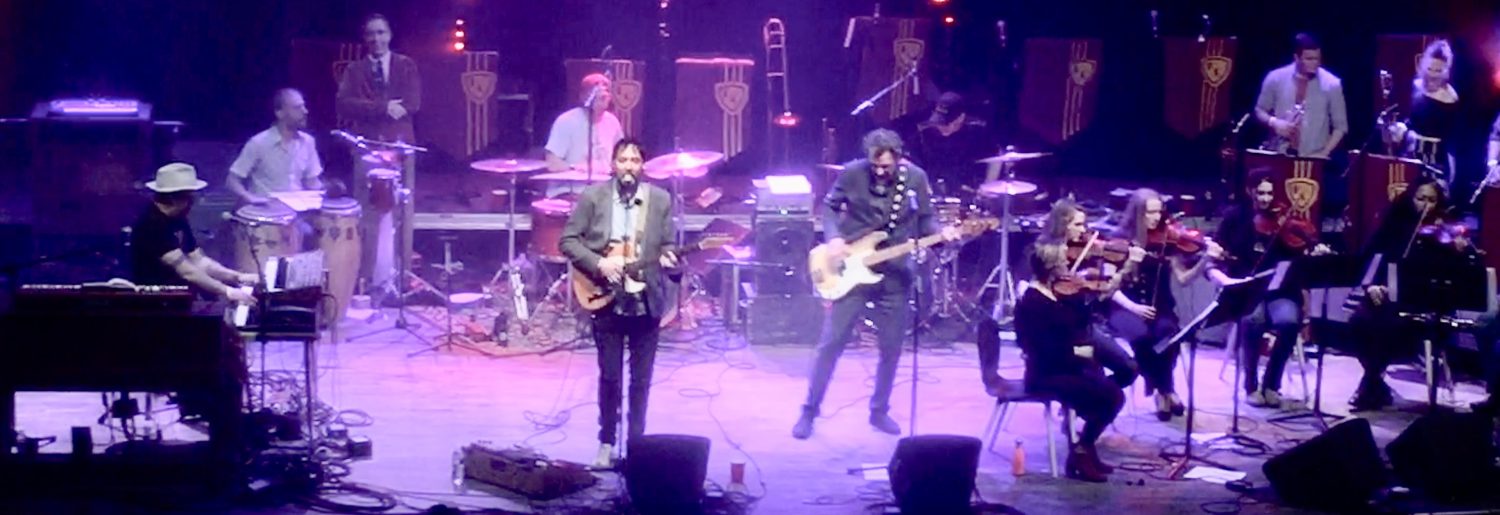

Albee alone
With a new band and a growing résumé as a local producer, Spence makes a name for himself outside of his Rustic day job
Originally published Oct. 13, 2000
Frankenstein is an apt name for Spencer Albee to adopt. The whole that he projects is certainly the sum of a number of parts. He’s the keyboardist for Rustic Overtones, and like everyone else he’s waiting for the album [what would be Viva Nueva] to come out so they can get on with their musical lives. That’s a given. But as of October 14, with a performance at the Skinny as part of the Shebang music festival, he will be the frontman for his very own band, The Popsicko. Albee will then release a 14-song album —Frankenstein Presents The Popsicko, Vol. 1, on which he sings and plays 90 percent of the instruments — October 31 through his own imprint: FPFC, the Fun Portland Fun Club.
He’s the man in the big cowboy hat, curled up and weather worn. He’s Captain Beautiful on the 1995 Rustic Overtones record Long Division. He’s currently sporting a pinkish stripe of a goatee, saying with a straight face that he’d like to be known as Frankenstein. “Do you think I’d run into copyright problems with that?” he asks earnestly. He figures that as long he doesn’t use the image he’ll be fine.
And that’s not all. Albee has become the producer-in-demand around town. In the past year he has manned the board for Loud Neighbor’s initial 10-song demo, No Gain; four 6gig tunes, including the single “5” that’s getting all kinds of radio-play in anticipation of Tin Can Experiment’s release on October 16; and a good portion of Jeremiah Freed’s five-song demo. He even produced the last song, “You Could Be Mine,” on Jenny Paquette’s latest album, See What You Do, and, starting late this month, he will begin production on a new Hawthorne album, Traces of the Muse, which will appear in early 2001.
Whether he’s Albee, Frankenstein, or the King of France, he is a driving force in the Portland music scene, and more than just an industrious 24-year-old. He’s talented as hell.
Just ask Shawn Saindon, local singer/songwriter and the organizer of the Bull Moose Shebang event that will feature 14 local bands in all. He signed up The Popsicko before the band had even played a show together, or even practiced together as a working band. “I heard the CD from Spencer a couple months back and it blew my mind, and I knew it would be successful,” says Saindon, an admitted pop fan with a penchant for the Beatle-esque sounds that pervade the disc.
Saindon was also impressed enough with Albee’s production abilities to enter into talks with him to produce his next album, though their schedules have so far precluded setting a date for getting in the Studio (capitol “S” intended; it’s the sometimes confusing name of Tim Tierney’s studio on Casco Street in Portland). His production is “really slick for a local producer,” says Saindon. “He’s got a lot of talent for using the technology he has to get that national-act sound. He and Jim Begley are really into the music that they do.”
It is telling the Saindon mentions Begley, as he and Albee have become inseparable as a producer/engineer team, working together as early as the 6gig project, and even earlier than that. “The people we were each living with were both coincidentally getting married,” recalls Begley. “So we were left as bachelors, and we ended up living together for about a year.”
They discovered that they had a lot of mutual interests — Spencer a performing musician with Rustic Overtones, Jim with a degree in music performance from UMass Lowell and a trained studio engineer working at the Studio — and they ended up doing their first recordings right there in their kitchen. Begley would bring mics home from the studio and they’d work with whatever they had on hand getting some of what would eventually be The Popsicko on tape.
It was only a matter of time before they started collaborating on professional projects. Finally, the opportunity presented itself. “He was friends with 6gig,” says Begley. “So I set it up at the Studio, and Spencer sold us as a team.”
Albee has a penchant for recognizing a break and going for it. “I was at Prime [Artist Studios, a local practice space] when Walt [Craven, 6gig’s lead singer] was at Prime,” recalls Albee. “And then Steve Marquis [6gig’s guitarist] was in with Rig, his old band, doing “Hit the Ground” at Big Sound, and I said, ‘We really need to get that.’ ”
Albee and Begley ended up recording and mixing four of the songs that would eventually wind up on Tin Can Experiment. Ultimatum Records licensed and re-mixed their original production, combining the result with the efforts of legendary producer Ron St. Germain, who has heavyweight albums by Creed and 311 on his résumé.
“That was my real foot in the door,” says Albee.
It didn’t hurt that Albee went through the experience of recording the Overtones album for Arista. “I learned a lot from working with Tony Visconti, David Leonard, Roger Sommers,” all seasoned industry producers, says Albee, “I got to sit and watch them work, and now I can listen to records and say, ‘I know how that happened.’ ”
If the new Popsicko album is the evidence, it’s pretty clear that Albee now knows how to make things happen as well. The record was put together in bits and pieces, whenever Begley, Albee, or Studio head engineer Steve Drown could get away from the grind to record. “We all hit it off,” says Begley. “Spencer and I did a few tunes, Spencer and Steve did a few tunes together, we did a few tunes with all three of us. It would be whoever was available.”
The same was true of the “guest musicians” that play on the project. Eggbot plays the coronet. Jeremiah Freed guitarist Nik Goodale lends soaring guitar riffs. Spencer’s sister Katherine sings backup and plays some horns. Begley plays drums. Drown plays guitars. Overtone Ryan Zoidis lends some saxophone. Overtone Jon Roods even recorded a bass track in the old kitchen. When the Popsicko plays out, Albee will be out front on guitars and keys, while Eggbot handles the rest of the keyboard duties. Begley, who also fills in for Motor Booty Affair on occasion, will play drums. Pat Hodgkins will play bass. Albee’s old friend Adam LaCasse will come up from Boston for lead guitars, and sister Katherine will lend backup vocals and horns.
Because of this catch-as-catch-can approach, each song on the disc takes on its own personality. “The cool thing about doing tunes one at a time,” says Begley, “is that every song sounds completely different.” Some are decidedly low budget, where they were going for an old-school production value; others are very, very slick, making use of every effect available. Each song is clearly a different experience for Albee, and it seems natural that each song should have a different sound and feel.
“Two Feet,” the first single, is driven by Albee’s blues piano and a crescendo of voices in a very hip radio chorus. The production talent is in the little things: a bridge that consists of an apparent lunatic rambling in the background; a fade-out of Albee whistling the melody while he snaps his fingers to the beat.
What directly follows is a Ween-esque send-up of the Portland bar scene: “Beer Goggles.” This time it’s space-age synth effects, wild yells in the background, and crunching guitars that define the sound. Blur-like “whoo-hoos” carry the song home, until Albee sneaks in a little classical piano over the distinctive sound of someone scanning the radio dial for something different.
Which is then, of course, what the listener gets, with “The Mess I’m In.” All of a sudden we hear Albee over the top of simple synthesizer chords that reveal his undying reverence for Paul McCartney’s Wings. It’s Beatles with a disco ball, Sergeant Pepper in a vinyl suit. There are soaring George Harrison “oohs,” “aahs,” and guitar solos. The high-pitched John Lennon “yeah” feels so right.
“I love the Beatles, but there’s something about Wings that’s just different,” says Albee. “They’re the one band that define the ’70s. I feel like I was born at the wrong time; I wish I was 24 in 1970, so I could witness the birth of heavy metal and synthesized funk.” And if we take “The Porno Song” as an example, he’s also interested in living some of that decade’s depravity. “Spread your cheeks, show me that ass,” says an anonymous porn star repeatedly in a seamless splice. “Do you still want me?” he asks. “Yes I do,” replies the imagined blonde. What follows is a hilarious plea to be “like the guys in the magazines, getting laid, getting paid.” Surrounded by serious songs about world peace, getting over bad relationships, and dealing with corporate greed, it is a calculated risk. Yet, says Albee, “it’s my mom’s favorite song. I mean, some parents may be offended by it, but if they’re parents they had to have had some porno in their lives at some point.”
It’s all part of Albee’s æsthetic, which is appealing to more and more folks all the time. “He knows that I am looking for him to bring us into hipness,” says Hawthorne lead singer Mike Falkingham. “Our big weakness was that we were writing what we thought were really good songs, but were missing a very tiny thing that could turn it from a mediocre song to a very high-quality single or album cut.” Falkingham believes that Albee can provide just the right amount of mojo. “Spencer will not change what Hawthorne is,” he says, “but he can do anything and everything he wants to make the sound better, throw in effects, a sample, anything.”
All of this points to questions about whether this solo activity as producer and frontman might be a safety net against a worst possible Rustic scenario. Could Albee and Begley become a producer/engineer team on the level of Mitch Froom and Tchad Blake, who work with Cheryl Crowe, Los Lobos, and Soul Coughing; or Mark Howard and Daniel Lanois who oversee albums by Willie Nelson and Emmylou Harris? Is Albee ready to take his pleasing pop voice and step out from the shadows like a Phil Collins leaving Genesis? We’ll find out.
“It’s just something else that I like to do,” says Albee. “I really enjoy being in the studio. I like working with other people and artists, and right now, it sure beats all the shit jobs out there. The work may have its ups and downs, but I can keep my life simple.”

 Portland's Best Albums | Maine Music Reviews