

Step into the night
Cambiata release a dark and intriguing debut
I’m the first to admit that it can be hard to follow the all-ages scene. So many bands come and go in so many far-flung venues, only those fully immersed in the scene could hope to speak confidently about the brightest new prospects. I’m not that guy.
I can tell you, however, about the cream that rises to the top. The Cambiata are populated with talent that has burned brightly enough to be noticed by anyone paying attention over the past five years. Guitarist Sean Morin and drummer Daniel McKellick were once among one of the best young bands in Maine with Barium, a hardcore outfit that was part of an all-ages and DIY explosion in the late-’90s. Singer Chris Moulton was more recently frontman for In the Arms of Providence, whose Left My Voicebox in a Seaside Town was one of 2005’s very best releases, before the band imploded, and his team-up with Even All Out’s former frontman Billy Libby set the scene’s heart a-flutter for about three months just after that.
 Together, the trio are joined by bassist Stan Dzengelewski and guitarist Miguel Barajas, partners in Originel, to form a five-piece brain trust of heavy, aggressive music influenced by facets of hardcore, jazz, emo, synth-pop, and rock. They ask a lot of their listeners, but if you’re looking for something you haven’t heard before, as likely to beat your face in as sing you to sleep, Cambiata are your band.
Their debut full-length, Into the Night, released with the help of promoters/management Burning Baltimore, smolders with a desire to be different, to go places you haven’t been, to shine with such luminescence you’ll be caught unable to either stare intently or look away. Sometimes they succeed. Sometimes they come off like pre-schoolers yelling, “look what I can do,” from the playground monkey bars, but, as with the toddlers, you watch and listen because you’re ready to be impressed.
Stealing from the school of Mr. Bungle, Cambiata revel in the jarring transition, as in “Frankenstein,” where four bursts of screaming and disjointed instruments start and stop with impressive precision. This band is tight as hell. And when those four bursts return later in the song, the silences in between are filled with flourishes like a voice mocking, “You go right to your room, mister.” They embrace and reject song structure, forcing you to listen for the chorus, for the song’s heart, as they switch time signatures and keys with wild abandon.
Just try to get Moulton to stick with one delivery. He does screamo just fine, and often, but he also mixes in a knowing Brit-pop, a breathy earnestness, soulful R&B crooning, and cynical talking. The jazzy drum and some delicate Wurlitzer from Morin on “Shards of Pornography” introduce Moulton as lounge singer, and the lyrics suggest a self-questioning that fuels the experimentation and the passion: “I met a girl today who said she likes to cut her legs, but said I shouldn’t worry / But I do/ Her ambiguity is cruel / But I guess I’m okay … Why do I seem to rub everyone the wrong way / And fail to make myself clear?” That’s followed by a progressed chorus that leads him to offer, “I am on the threshold of offing myself / for the pain that I seem to cause everyone else.” Easy like Sunday morning, the band show their chops with “Whoah-oh” backing vocals and an ability to play soul with a smirk, before finally cycling up into a full-on rock tune, Moulton’s vocals turning from croon to chaos.
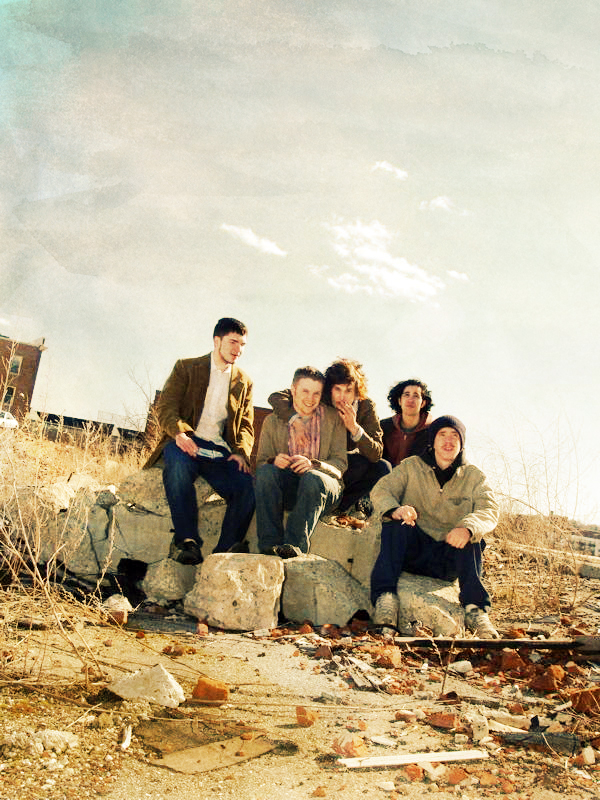
The Cambiata. Photo by Richard Fortin.
And that’s not even the best transition here. “Birth” opens with that breathy delivery over some light guitars, like Elliot Smith, but the end of the verse sees Moulton holding on to “fine” while he arcs up in the register and the band charge in like a herd of elephants. Later, a twist on this construction finds picked out guitars, contrapuntal, bouncing from one channel to the other, while the drums take a bit of a solo, using some cowbell, before the band again charge back in as a whole. The dueling structures echo the mixed emotions of the chorus: “Send my lovechild to the Golden Gate Bridge / You’ll feed her with your likeness like her father couldn’t.”
The anticipation of what might come next is alive on this album even in a third listen.
Is it true that I’d love to hear these guys in traditional alt-rock mode, pushing through wonderfully melodic verse-chorus-verse numbers behind Moulton’s powerhouse vocals (or even simply more songs like the relaxed jazz number hidden at the end of the record)? Absolutely. That doesn’t seem to be Cambiata’s bag, though. It’s clearly important that each song do something unexpected, that there should be a five-listen investment before you could hope to sing along. I’m fine with that.
This is a challenging record that makes me think about what makes a song a song and gets me actively recalling music from disparate parts of my collection, but I wonder if Cambiata realize that they can separate themselves plenty just with their musicianship, with their talent, with a few very finely turned phrases. Are they being different just for the sake of being different, thereby missing the chance to be different simply by standing out? That’s the question to which I hope they know the answer.


 Portland's Best Albums | Maine Music Reviews