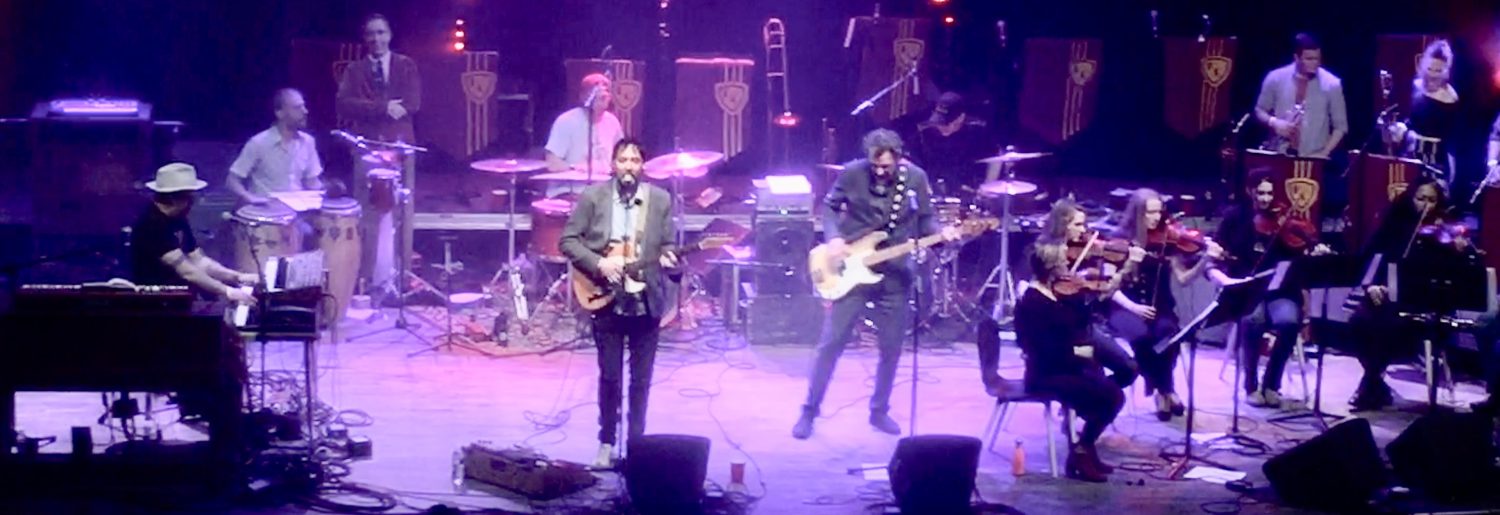
Rustic Overtones: Let’s Start a Cult

Cult of personalities

Rustic Overtones want you on their side

What’s the go-to motivational tactic used by every coach of an underdog team or demagogue looking to gain followers in a hurry? It’s us against them. Us against the world.

With Rustic Overtones’ eighth release, released in 2012, you’re either with them or against them. They don’t really care which. Let’s Start a Cult is everything their previous release, 2009’s New Way Out, wasn’t: All those string parts? Gone. The big and symphonic works that added up to an hour of music? This time they’ve stripped down to eight tunes and three minutes shy of a half hour. The guest players and revolving line up? With the addition of Gary Gemitti on drums and Mike Taylor on keyboards, they’re back to being the line-up you know and love: three horns, guitar, bass, drums, keyboard.

That doesn’t mean they’re back to hitting up-stroke ska songs and fire-breathing anthems, though. For this release, at least, they’ve gone much more organic, almost Edward Sharpe in their pop construction at times, and with a touch of lo-fi aesthetic that feels raw in a way they haven’t felt since before they were in the studio with Bowie.

It’s no mistake. “I like it gross,” Dave Gutter slinks on the devious “I Like it Low,” “I like the smell of cigarettes inside my clothes,” and there’s a baritone sax from Jason Ward that slithers through the weeds before being picked up by Ryan Zoidis’s tenor sax and a gritty trombone from Dave Noyes. The horns as a whole feel more part of this album than anything since before the hiatus – that you don’t really notice them is perhaps the best compliment I can pay to the arranging. They are wholly of the songs, rather than being ornaments.

“If there’s something you’re feeling inside, you should let yourself go.”

Oh, they’re tempting all right. “Let’s Start a Cult, Pt. 1” gets you right from the open with a poppy little flute line and digital hand claps and an “ooooh-oooh” bridge: “They can’t stop us all / How can they stop us all? / If we’re together.” They’ve embraced some new-school digital production here, too, integrating it so they manage to be space-age and ‘60s pop at the same time.

Just like they can combine old-time bluesy ballads with ‘80s sax lines in “Say Yes,” where Gutter knows how easy it can be to just join crowd: “It was hard to resist / They were pumping their fist / They were raising their flag in the distance.” His flittering guitar ain’t bad here either.

Gutter’s turned out some of his best lyrics in a while, too. The indie/big band “Solid” has this gem: “That’s not a halo, that’s a hole in your head / It’s not cold in the place that you go when you’re dead.” Ouch. It’s as mean as the low down Jon Roods bass that fuels the verse of “We’ll Get Right In” before it launched into melancholy pop for the chorus.

Remember? You’re with them, or you’re against them. And if you’re not with them? Well,  as the ultra-dynamic album closer says, “fuck it / Let’s go out with a bang.”

An Overnight Low: Euston

Last train outta Euston

Part one, from Chad Walls’ An Overnight Low

Chad Walls is a guy who’s still dedicated to the album format. Like Zach Jones and his Days, he wants to tell you a story. It’s just that he’s decided to use a group of songs with which to do it.

As a narrative format, of course, the album lags behind the novel and the film, and it requires a bit more attention than either. Words are sort of important to stories, especially when you don’t have pictures, and the words of songs are meted out in phrases and abstracts. Sometimes with vocal delivery that makes them hard to make out. What is like a little movie to Zach Jones might be more of a general emotional impression to you. Like watching a movie on the bus to Boston while you’re listening to your own music and with the screen three seats up.

You get the general idea.

With Euston, Walls is writing and performing as the project An Overnight Low, for which he’s put together a live version and which involved a number of contributions from local session players gathered by Jonathan Wyman. And Euston is just the first album in a three-part project he’s got all mapped out, and much of it completed, documenting bits and pieces of his stay in Manchester, England, while he took three years to get a doctorate.

The ensuing work isn’t quite as cerebral as all that sounds, though. Walls is a pop-music guy and has been since he was writing songs with the boys in the Frotus Caper back in 2001. Thus, he tells his stories in sharp, three-minute chapters. The 10 songs on this first record are all done in less than 30 minutes.

He’s not nearly as manic and upbeat as the Frotus often found themselves, though. With an acoustic guitar strum as foundation, they are mostly more subdued. There is an alt-country weariness to much of it, fueled by the kind of nostalgia that can be induced by sifting through the detritus of three years abroad.

This is encapsulated most succinctly in “Terminal B,” a two-minute, transitional tune that’s just Walls, an acoustic guitar, and sparingly administered feedback. Like “Skyway” on the Replacements Pleased to Meet Me, your attention is drawn by the sparseness as Walls contemplates “songs on the backs of tickets” and the meaningless phrases of traveling: “Enjoy your stay, or welcome back.”

It’s the same kind of emotional impact as delivered by the album’s true standout, “London,” a tale of fleeting friendship and lives unraveling. The vocals are some of the highest on the album, making everything feel insistent and important, and Holly Nunan’s backing vocals weave behind the chorus – “least I remember it that way” – to emphasize the vapidity of the interaction.

She’s heard he’s been to London (no, it was Manchester, thanks), “how have you been? I think I lost your number.” Ouch. Were we close, once? It’s a truly arresting song, to make you think of those friends you were closest to, but don’t really have much in common with anymore.

Such are the songs that come with age and experience. Walls is no spring chicken anymore, and so songs like “The Artists in the Wrong World” have the benefit of perspective, of looking back. They also have the benefit of a lifetime of playing around with the song form, and so while you’re often expecting verse-chorus-verse-bridge, there are enough minor deviations to keep you interested.

That also means they can be pretty touchy-feely. “Halley’s Comet,” full of tambourine in the right channel, echoing backing vocals, and lots of splash cymbal late, is rife with foundational sentiment: “This is the place for me.” Same with “Sleeper,” which has its own echoing piece – “I’m not alone/ I am alone” – and closes with a somewhat mysterious repetition of “I don’t want to celebrate the Fourth of July yet.”

That’s what this album is about, though. Those life demarcations: weddings, funerals, holidays, meetings, and departures.

Like “Goodnight, Portland,” the most rock piece here, with a killer opening – “she’s just a first-draft drinker/ Who penned a paperback” – and a finish dripping with atmosphere and kick drum. The chiming electric guitar in the middle is like a second-hand ticking off time as rounds come and go at the bar, people and places come and go through your life.

Still, “that’s better than anything on the radio/ That’s better than anything underground.”