
The show must go on
The Cult of Rustic Overtones continues
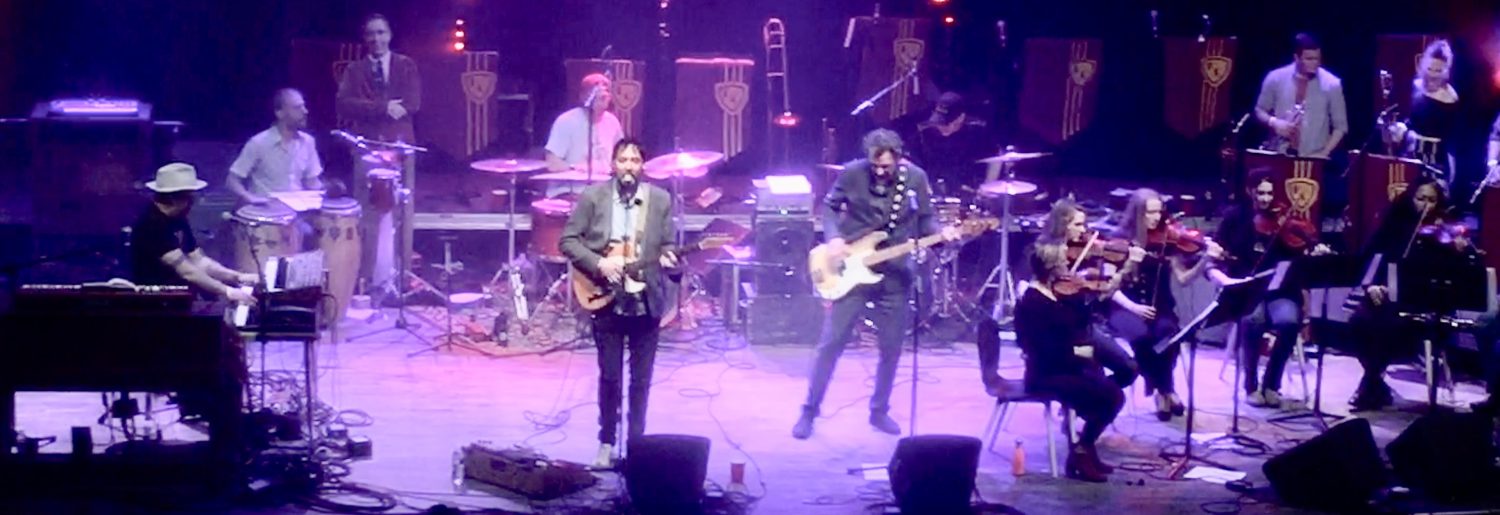
In the basement of the Franco Center in L/A this past Saturday [this was November 23, 2013] , various of the Rustic Overtones are signing CDs and T-shirts, posters and packs of Rizlas. Jeff Beam is upstairs opening their benefit show for the Good Shepherd Food Bank and the guys are eager to chat about their new album, a second volume to follow on 2012’s Let’s Start a Cult.
Jon Roods: “What do you think?”
Sam: “We were just listening to it on the way up. It’s so well orchestrated…”
Roods: “Yeah, we’re grown-ass men, now.”
 Later, watching the seven-piece band, augmented by a four-piece string section, there were certainly signs of maturity. Some gray hair, maybe thinning in places. Frontman Dave Gutter’s daughter gamboling about. Dave Noyes’ epic Cosby sweater.
You’d never know it from hearing them play their hits, though. They opened with a huge “Hardest Way Possible,” a song they’ve released on three of their now eight full-length records (it’s worth noting that next year will be the 20th anniversary of their first album, 1994’s Shish Boom Bam). The singalong that marks the second movement of “Rock Like War” was soaring. And “Gas on Skin” – well, from the extended, rippling jam to Gutter’s crisp and powerful delivery, it was as easy as ever to see why it’s been a live favorite since Viva Nueva in 2001. I’m not sure how you could stay in your seat for that tune.
Except there were plenty of fans sitting in the Franco’s Center’s plush red seats.
Hey, the fans are getting older, too. Just as there were plenty of kids who couldn’t help but crowd the stage, there was an equal contingent content to nod their heads in relative comfort. Similarly, while the Overtones may be playing live with as much passion and precision as they ever have, on their albums they have exchanged some of their youthful aggression and fire for a mature and worldly approach.
Be glad they did. The result of years of experimentation with ska, R&B, hip-hop, rock, and Latin sounds is some of the most progressive and interesting music being made today. While almost all of popular music can be bucketed into electronic/rhythmic, country/stringband, and radio rock, the Overtones continue to forge new ground with intricate horn parts, layered keyboard lines, and lyrical work from Gutter that shows he’s never been more inspired.
The biggest departure from the rest of their oeuvre on Let’s Start a Cult, Part II, though, comes in the form of Gary Gemetti, who has now truly settled into the drummer’s spot vacated by Tony McNaboe and brought with him a jazz-influenced, quick and light hand that drives the eight songs here with a skittering urgency you haven’t heard from Rustic before. What he’s doing live sometimes sounds like the programmed beats from the Postal Service. Good God is his cymbal work impressive.
He’s best on “Martyrs,” where the horns match his Latin vibe and help introduce a guitar solo from Lettuce/Soulive’s Eric Krasno. Gutter is quiet in the open, but lets energy seep into the first taste of the chorus and then consistently delivers the hook with evolving couplets. Best is this one: “We don’t need no torture/ We get obsessed over pleasure or pain/ Oh, we could be mothers and fathers/ We don’t need to be martyrs.”
Fans of his vocal work should notice that he’s still got the chops, delivering trademark screams on stage with everything he’s got while his work in the verses has tended to sweeten as he’s become more contemplative with age. It’s also worth noting, as on “Bedside Manor,” that Matt Taylor has finally filled the keyboard/harmony vocals chair in a way that hasn’t happened since Spencer Albee left the band half a decade ago.
Gutter’s wordplay on “High on Everything” is at its most agile and poignant. There’s a touch of “Gas on Skin” in the intro, and a better version of the low-down sulk of “I Like It Low,” and then Gutter insistently right in your ear: “They gave us alcohol, it made it hard to focus/ They gave us Adderall, it made us smell the roses/ They gave us Claritin, they gave us Ambien/ We woke up in the ambulance.” Gutter to delivers, too, a guitar break in the style of ’80s Jeff Beck.
At its core, though, this album is all about bassist Jon Roods. Not only did he engineer it, as he’s done since New Way Out, but his playing has become a highlight of the band’s songwriting. He’s present right from the get-go of “The Show Must Go On,” with a dynamic line that is the ultimate mood-setting for a song that, itself, is designed to set the mood for the album as a whole, with Beatles-style backing vocals and vibrant horn lines.
If Roods isn’t the most musical bassplayer in town, I don’t know who is. On stage, he and Gutter have become inseparable, always set up in tandem to the front, with Roods acting as an unflappable melodic foundation that allows Gutter to be emotionally pyrotechnic.
Such is “Us Vs. Other People,” with spacey keyboards, congas, and an ‘80s vibe like an R&B version of Alphaville. Combined with the horn lines, Rood’s bounce creates something like a fusion base that supports an aching descending vocal riff from Gutter in the chorus: “Still, in essence we’re the same.”
Which is all there is to it. This is a band with talent that has brought them into more side projects and opportunities than is worthwhile to recount. That has had every opportunity to abandon a big-band rock effort that hardly makes sense anymore in today’s music industry. While most bands pare into duos and trios to make the the finances work, Rustic goes ahead and swells to 11 pieces with the strings, as they did on Saturday night to magical effect.
Yet, still, in essence, they’re the same.
 Portland's Best Albums | Maine Music Reviews