Jerks of Grass: Come on Home

Home, at last

Jerks of Grass deliver a disc 10 years in the making

And you thought it was a long wait for that Phantom Buffalo record. While it may have taken those indie popsters three years to get their record out, fans of Jerks of Grass have been waiting a solid decade. Other than two tracks on the Greetings from Area Code 207 series (2000’s “Highway Paved with Pain” and 2001’s “Whitewater”), there has been nothing to bring home and put on the stereo for fans of what has been at times Portland’s hardest-working band.

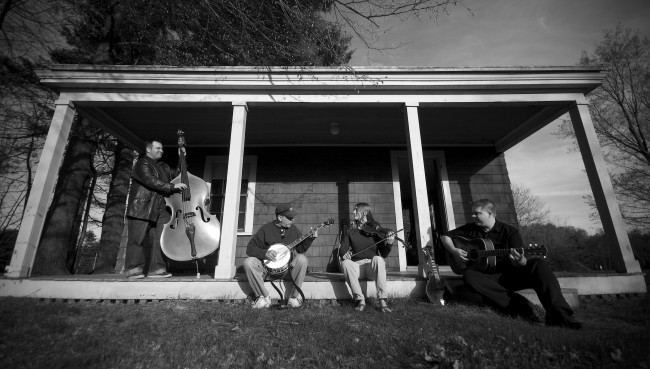
Admittedly, I am one of a very few people who has a copy of a full-length disc the band recorded back in 2000, with the late John Farrell on fiddle, along with Carter Logan on banjo, Ronnie Gallant on mandolin, Jason Phelps on guitar, and Tom Jacques on bass. I still listen to it, a disc full of fire-and-brimstone bluegrass and a hell of a lot of fun. That disc was never released, though. The band simply weren’t happy with it.

I think it struck them that it was bluegrass like a hammer to the skull, and that they were, deep down inside, better than that. For all the fast-picking virtuosity that would still impress more than just the casual listener, it wasn’t anything special. Just good players ripping up standards, really. [Here it is. My tastes have apparently changed over the years. I’m a simpler man, now, I think.]

Now, this weekend, the Jerks, differently constituted, will release Come on Home, a clarion call to their fans that, yes, they’ve got things figured out now and they’re ready for some of those bright lights and big stages.
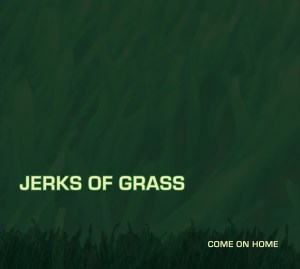
jerksofgrass_cdThis is perhaps most poignantly made clear by track 10 on the disc, “In the House of Tom Bombadil,” a song off the self-titled Nickel Creek album (when they looked like they were about 12, but played like they were in their prime). This song is flat-out mind-blowing, especially live, with intricate melodic runs and time changes galore. And it’s the kind of song that put Nickel Creek and Chris Thile, the mandolin player who penned the song, on the map as major talents. Here, I think it’s something of a statement by Phelps, who has long been known as a stand-out bluegrass flatpick guitarist, probably among the 50 best guitar players in the country. Know him now as a musician who’s legitimately phenomenal on two instruments, maybe more — this song is, as we say here in Maine, wicked hard, and is exactly the kind of song Phelps and Logan had in mind when they took the band in a different direction in 2006, parting ways with Jacques and Gallant, adding Kris Day (bassist with Harpswell Sound, King Memphis, etc.) and Melissa Bragdon (a classically trained fiddler), and remaking the band from one previously known as “faster than Metallica” (unfortunate words from the third-ever issue of the Portland Phoenix) to one understood to be flat-out virtuosic.

With Day, they’ve added yet another wrinkle: original tunes. Like the Portland Symphony Orchestra, the Jerks were for a long time just a really talented cover band. Now, however, they’ve debuted two terrific tunes that also debut Day’s vocal talents. He’s a good singer, with depth of feeling and a hearty tone you can swim in. “Something” is the better of the two, a waltz where Day actually plays guitar and Phelps takes over stand-up bass (the bastard — he never stops showing off, really), while Logan handles the dobro (he also proves himself a master on the guitar, later) and Bragdon creates an accordion-like drone with nuance-filled bowstrokes on the fiddle.

These songs are vitally important to understanding the Jerks as artists, rather than incredibly talented performers of other people’s songs. There are times when you wonder — while listening to an impeccably rendered “Stomping Grounds,” say, replacing Jeff Coffin’s tenor sax with Bragdon’s fiddle and bringing more warmth to the song than Bela Fleck, Future Man, and Victor Wooten ever managed — whether anyone might create the same band, by simply practicing the same riffs for hundreds and hundreds of hours.

But the originals inspire you to listen more closely to their rendering of the Fleck tune, to listen to the way Bragdon so wonderfully holds down the rhythmic duties along with the guitar and bass, making Future Man’s “drums” seem downright silly, the banjo seeming to move with every power that inertia has ever granted.

There are any number of great choices here, to which only true artists could lay claim: the selection of “Twin Peaks,” by stand-out Czech mandolinist Radim Zenkl, a name casual bluegrass fans should latch onto; the Texas swing of “Foggy Mountain Special,” written by Gladys Stacey and Louise Certain, though made popular by their husbands, Lester Flatt and Earl Scruggs, and offering an opportunity for Day to show off a slap-heavy bass break; the “Tennessee Waltz” that shows off Bragdon’s long bow strokes and pure pitch so well, written by Pee Wee King and Redd Stewart (as legend has it, on the back of a matchbook) in 1947.

Go look Pee Wee up some time. The guy was the first to use an amplifier or drums on the stage of the Grand Ole Opry. The Jerks are the kind of band that know and respect that.

For sentiment’s sake, “Why You Been Gone So Long” is probably my favorite song on the album, just for it’s pure singalong quality, and the great, great delivery Phelps has always had on “There’s nothing I want to do/So I guess I’ll just get stoned/And let the past paint pictures in my head/Drink a fifth of Thunderbird and try to write a sad, sad song/Tell me baby now why you been gone so long.” It’s by the now-deceased Nashville songwriter Mickey Newbury, who wrote for everyone from Elvis Presley to Kenny Rogers, but was known as one of the first Nashville outsiders, independently recording some 15 of his own records.

In many ways, the Jerks have always been outsiders in Portland, despite haunting just about every club the city’s ever offered. Though they’re beloved by nearly everyone who’s ever seen them, and are universally recognized by their peers as some of the city’s finest musicians, they’ve made the basement bar that is the Bramhall Pub their home away from home for more than a decade, no show ever really being anything more noteworthy than another.

It’s time to come out into the sunlight, guys. This record is something special.

Photo credit: Matthew Robbins
Labor Day Records: Beautiful Locals

Just Beautiful

For fans of the Locals, here’s a disc just for you

*This dates to 2005. I’m going to leave it mostly as-is.

Though its membership seems to be increasing, the group of people who really know local music — who have it in their regular rotation, in their car, and can talk knowledgeably about it — is fairly small. Perhaps regular readers of “The Beat Report” [my column in the Portland Phoenix at the time] make up a large portion of that group. So here’s a test (answers appear in “Sibilance,” linked off the music page [this refers to print – we didn’t bother to change it on the web page]) that might serve as an initiation requirement:

1. Name the original five members of Rustic Overtones.

2. What was Lincolnville’s name before it was Lincolnville?

3. Which former King Memphis member now plays in Harpswell Sound?

4. What text appeared on Twisted Roots T-shirts?

5. Name all the Spencer Albee-fronted bands.

6. What was Munjoy Hill Society’s original name?

7. What band contains members of former Portland bands Goud’s Thumb, Twitchboy, Tripe, and Ku-Da-Tah?

8. Which Horror member was once a member of the hip-hop group kNOw Complex?

9. Which former Silos frontman died in an accident in 1993?

10. Name three bands with whom Neil Collins has played.

Okay, how’d you do? Did you pass? Anything above 60 percent and I’d be pretty impressed, even if #4 is a gimme. If you even thought hard about the answers, though, you’re going to be thrilled with a project, to be released March 1, that’s been organized by Mark Curdo, honcho of the brand-new Labor Day Records and a guy who’s been involved in Portland music since he worked as a DJ at the St. Joseph’s radio station WSJB in the mid-1990s.

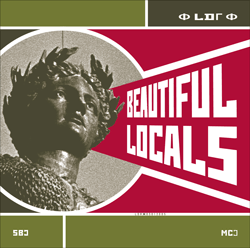
Beautiful LocalsRiffing off the Goud’s Thumb song title “Beautiful Local,” Curdo has createdBeautiful Locals, an album consisting exclusively of Portland bands covering songs by other Portland bands, both past and current. It’s inclusive, diverse, interesting, and, most importantly, makes for a great listen.

If you haven’t heard the back story yet, I’ll give you the capsule review. After some time in the music industry proper, and New Jersey (ick), Curdo returned to the Portland scene looking to do more than just manage bands, as he had done with bands like Rotors to Rust and Rocktopus. He wanted to work with lots of bands, so it made the most sense to start his own label.

But, he says, “I didn’t sit there and say, ‘I’m going to start blah, blah records.’ I was looking for a more honest way for me to start this venture.” Remember, he wanted to work with lots of bands.

“I’m a big fan of covers,” he says. “But I don’t like compilations. Most are crap. The ones that work are those with a very odd pairing of things. A soundtrack to a Wes Andersen movie or something. I thought that I could do something of a compilation of Portland bands, but I didn’t want them to just put out their songs. Anybody can do that.

“I just thought about these bands getting together and somehow bringing together what’s happened over the past 15 years specifically — which I think is where it’s been strongest — and really trying to tie it together, which I don’t think anybody’s really been able to do. So I thought, ‘How about Portland covering Portland?’ ”

Not surprisingly, “The ideas of who would do what started racing through my head and I thought this could be really cool.”

Curdo started out with a list of about 60 bands he saw as possibilities and then started narrowing the project down using the following criteria: “classic artists balanced with new stuff, bands that are just breaking through. To get young kids who are listening to ’CYY to find out about, say, Twisted Roots or Goud’s Thumb, and, vice versa, to get people who used to go to the State Theatre but don’t know about the Press or Eldemur Krimm. I like turning people on to music and this is a way to do that.”

Then it was just a matter of making tough decisions about whom he would approach and whom he wouldn’t. “That was the toughest part,” he says. “It wasn’t the biggest bands. Sometimes, it was just some bands I knew better. Some bands I felt had to be a part of it; it couldn’t be complete without them. And I wanted to take some chances with bands who’ve been working their asses off and deserved a shot with something cool.”

The end result is definitely weighted toward the musicians you might find hanging out at the Big Easy on a Saturday night, and it could be said that the hip-hop, punk, and roots scenes are under-represented, but it’s not like Curdo is working with public money here. It makes sense that the project is also a reflection of his own musical tastes and the bands that began his own love of local music in the first place.

Further, by taking such a tight-knit group of musicians and putting them on to a project like this, Locals winds up being Greetings From Area Code 207 to the next level, not only showing off the incredible talent we have residing here in Portland, but also allowing that talent to pay homage to the scene itself, reveling in the minutiae and details that only people who’ve been directly involved would appreciate.

That’s why, though it’s a collection of covers, the compilation contains very few instantly recognizable songs for the casual fan. Few of these songs have been on the radio, despite the fact that many local songs get play on our commercial stations. Few of these songs are “singles.” Instead, the bands on the album have chosen their favorite tunes, those songs that inspired them and got them amped up to play their own songs, deep cuts from albums that personally affected them.

This also leads to one of the album’s few problems, in that many of the bands seem to so respect the bands they’re covering that they don’t fully make the songs their own. Sometimes, the songs don’t sound that different from the original version.

“The toughest thing [for the bands] was who to do,” says Curdo. “I didn’t want to dictate any of that. The fun of it was them choosing the songs. I think I could have matched bands and songs really well, but I wanted the bands to do that.”

For instance, “Twisted Roots were really psyched to be involved. They were very pro Darien [Brahms]. That pushed me over the top to get hold of Darien. Turned out both of them wanted to cover Manny Verzosa, so the two of them had it out and talked it over.” In the end, the Roots took Verzosa’s “Tuesday,” and Brahms had the band back her up for Mark Farrington’s Cattle Call tune “Take Control.” That’s what’s so right about this project.

Verzosa’s incredibly respected by the local community (note his two songs on the GFAC discs), but little known by the general public. Brahms told me a story once about being on tour with Verzosa for her 21st birthday, where he pumped her full of booze like any good older brother would, so she wound up playing hungover as hell for the little geniuses of Simon’s Rock College. That’s the way I’ve come to see Verzosa in total, as a kind of older brother to the Portland music scene. And Twisted Roots strike me as his metaphorical high-school buddies, those kids who came over all the time to eat out of the fridge and who you wanted to impress.

Their “Tuesday,” which they only ever had a bathroom demo of, comes with a spare opening that gets to Verzosa’s roots with just a backing rhythm guitar and faraway drums, but then launches in to the full Twisted Roots, anthem-rock treatment, full of Giordano’s soaring vocals and blasting guitars.

And they get Brahms a bit out of her shell, too (not that she’s really in one). Her opening to “Take Control” wouldn’t sound out of place on her last album, but once the coda takes over, with Brahms and Giordano trading off with plaintive “take me home”s, she really seems like she’s ready to kick some ass.

Then there’s Pigboat doing a crunching “Epiphany,” a Rotors to Rust song that was never even released on record; Tony McNaboe doing the Troubles’ “Heartfull of Heartache,” a deep cut off the classic-rock band’s Here We Go Again, with full R&B arrangement; and Adam Flaherty taking his ultra-indie voice to Lincolnville’s “Kill the Show,” which always played second fiddle to their smash “Heavenly Calm.” Even hardcore fans are unlikely to recognize the Horror stretching out Eggbot’s concise pop gem “Heaven Needs Babies, Too” past eight minutes with psychotic abandon. Eggbot has yet to release it himself.

Not that everything’s obscure here. It’s thrilling to hear the album open with Dave Gutter, Portland’s signature frontman, taking on 6gig’s “Hit the Ground,” possibly the biggest rock radio single to ever come out of Maine. Paranoid Social Club amp up the rhythm and throw in some explosive samples. Tony McNaboe’s WCLZ smash “Destination” is here, too, recorded live by the Pete Kilpatrick Supergroup, a direct opposite to the studio construction of McNaboe’s solo project, where he played all the instruments.

It’s fitting, too, that the now-defunct Even All Out’s take on the album’s namesake is the best track. It’s central to the disc, coming in at track #10, and is pure radio rock. Billy Libby demonstrates the pipes that thrust Even All Out into the public consciousness in the first place throughout the opening verse before opening up into an expansive chorus, “and it seems like you forgot, and I knew you would.” Yes, most us have pretty much forgotten about Goud’s Thumb, haven’t we? Here’s a great reason to remember them.

King Memphis, however, seem to be having the most fun of the lot. Normally confined to the genre-specific and exacting world of rockabilly, the Memphis boys really play with Eldemur Krimm’s rocking “Chopper.” They pick out the opening “Now this here’s a story . . .,” guitar, bass, and drums locked into a little walk, then blow your doors off with some serious surf and Robbins vamping it up all over the place, especially on the chorus burlesque. Then follows a ripping guitar break (what would a King Memphis song be without one?) nearly a full minute in length, a final verse, and then a finishing voiceover, as though the band were wishing a crowd good night.

“We hope you had a good time,” says Robbins. Then he asks drummer Gary Burton, “Gary, did you enjoy yourself?” He screams. Then, “How bout you Chris, did you have a good time yourself?” Chris Day screams, “Woooo.”

Yeah, the musicians on Beautiful Locals are pretty clearly having a good time. How else can you explain 16 bands getting together to record 16 tracks in about three months’ time (mostly with Jim Begley over at the Studio) for a project they really have no vested interest in? That pure love of the project tangibly carries through to the music, and that’s something you just have to hear.